
The most valuable person in the room might not be the expert or the executive.
Think about the last cross-functional decision that actually went well. Who made sure everyone understood what they were really deciding?
Chances are, a name came to mind. It probably wasn't the most senior person in the room. It was the person who kept asking, "Wait, what does that mean for them?" until everyone could finally answer.
That person is a translator.
Once you learn to see them, you notice them more frequently. You also start to realize just how much of the organization depends on them.
The room everyone recognizes
Picture a meeting about a problem or project that touches the whole business.
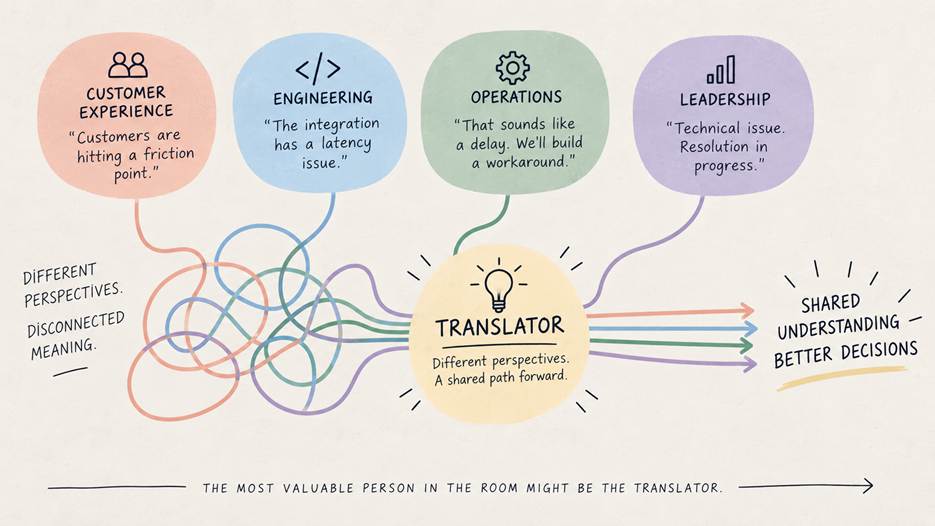
Customer Experience reports that customers are hitting a friction point. Engineering says the integration has a latency issue. Operations hears "a delay" and builds a workaround. The executive receives a slide that says "technical issue, resolution in progress."
Everyone in that room was accurate from their perspective but nobody was truly understood.
It rarely looks like failure. There is no outage or missed deadline, just a slow leak of meaning at every boundary between teams.
I know this gap well because I live in it, at the intersection of CX, strategy, and technology. It took me a long time to see that work as translation, and even longer to understand how powerful it can be.
When we made a major change to our ecommerce platform, the project touched nearly every function, from finance to fulfillment. Early on, ecommerce, project management, and engineering considered an order successful the moment it landed on the new platform.
From where they sat, that was reasonable.
From my seat and others like finance, it wasn't the finish line.
An order isn't complete because one system received it. It has to move through every system required to reach fulfillment. A customer never experiences the moment an order lands on a platform. They experience whether it shows up.
I spent much of that project turning each team's definition of "done" into something the next team could act on.
What a translator actually does
The translator is not usually the technical expert or the executive. They do something neither is fully positioned to do.
They understand what engineering means, not just what engineering says. They explain it in terms operations can act on. They understand what customers are experiencing, which is rarely captured by a single dashboard. They convert that experience into business impact leadership can weigh.
Then comes the hardest part: making sure everyone is aligned so the decision that was made is actually the decision that gets carried out.
Each step requires standing in someone else's seat, which is exactly why great translation is so rare.
The translator's edge isn't mastery of every function. It's having enough fluency across functions to recognize where meaning is getting lost, ask the right questions, and make sure what one team knows becomes something another team can actually use.
The power nobody assigned
Translators rarely produce a visible artifact, so their contribution can stay invisible. Yet they hold real power, just not the kind that comes with a title.
They shape which details reach leadership and how those details are understood. They influence whether operations hears a warning or an inconvenience, whether a technical constraint becomes a business decision, and whether a customer's experience arrives as a story or a statistic.
Whatever gets understood shapes what gets decided and the translator sits upstream of all of it.
There is an uncomfortable imbalance here. The people influencing some of the most important decisions are not always the most senior, and they are rarely recognized for the role they played.
When those people burn out or leave, organizations often discover just how much connective tissue they were quietly providing.
Modern enterprise work only makes this more important. We have more specialized teams, more platforms, more data, and more handoffs than ever. Every new boundary creates another place for meaning to potentially get lost.
How to spot one
Translators rephrase for comprehension instead of simply repeating.
They are trusted by groups that do not always understand each other. People consult them before the meeting because the meeting tends to go better when they're in it or seek them out afterwards for a debriefing. They ask questions that sound simple but expose assumptions everyone else missed.
If a name just came to mind again, you've probably found one.
Put them in the room earlier and credit the outcomes they helped make possible.
Claim the role
Translation is a muscle, not a personality type. You don't have to be naturally gifted at it. You just have to practice it with intention.
If you want to build influence across an organization, learn another function well enough to be corrected by it.
Before responding, restate what you heard and let the other person tell you whether you got it right.
When carrying information between teams, don't just repeat the message. Ask what the receiving team actually needs to know in order to act on it.
Afterward, check that the message landed, because saying something and being understood are two different events.
Do that consistently and something interesting begins to shift.
Curiosity about how other functions work grows, and those functions now become curious about yours! Teams that once spoke past each other start asking better questions. Problems surface earlier and decisions travel further without losing their meaning along the way.
That is the influence no title can give you. Your organization already runs on translators whether you recognize them or not.
Notice them. Back them. Become one.
Reimagine Collaboration and Communications with Enterprise Connect
All In on What’s Next
For over 35 years, Enterprise Connect has been the premier event where IT leaders, solution providers, and industry analysts come together to define the future of enterprise communications. As the most trusted conference in the industry, we deliver cutting-edge insights, world-class networking opportunities, and hands-on solutions that drive real business success.
Enterprise Connect is more than an event—it’s an experience that empowers enterprise communications leaders to reimagine the future of work. With elevated content, curated networking, and an engaging atmosphere, it remains the must-attend conference for professionals shaping the industry’s evolution.
Our mission is to equip you with the tools, strategies, and actionable insights needed to address your organization’s unique challenges. With industry transformation in mind, this year’s program introduces fresh new conference tracks, including:
- Legacy Unleashed: Optimizing Your Communications Backbone
- Workplace Reimagined: Engineering Tomorrow's Collaboration
- Tech Disruption Zone: Implementing Without Imploding
- Achieving Transformation: Architecting Your 3-5 Year Roadmap
- Future Shock: Communications Tech Beyond the Horizon
Featuring the most comprehensive program of objective content and an expansive vendor-neutral expo hall, Enterprise Connect is your ultimate resource for advancing collaboration, CX, and AV strategies. Join us to stay ahead, connect with industry trailblazers, and lead the transformation of enterprise communications.